



Stress is so common that we will all encounter it at some point or another in our lives. It arises from life events such as starting university, moving houses, bereavement, unemployment, relationship problems, and difficulties at work but the list is non-exhaustive. Stress sometimes can be a positive thing as it can kick us into action. For the most of it, it affects us in a negative way.
However, stress means different things to different people. Life events that might cause an individual severe stress might not affect another just as bad. How one feels is not as much determined by events and changes in the outside world, but by how these are perceived and responded to. One can learn to recognise own responses to stress and develop skills to deal with it.
In cognitive-behavioural therapy (CBT), the first stage of stress management is called the formulation. This is a map of how the stressful situations, your symptoms and coping style influence each other. Cognitions and appraisals are pivotal in the formulation.
Stress has many aspects: there are stress symptoms (cognitive, behavioural, physiological or emotional), stressors (life events, hassles or uplifts), and coping strategies (avoidant, emotional, including the use of alcohol, stress carrying or problem-solving).
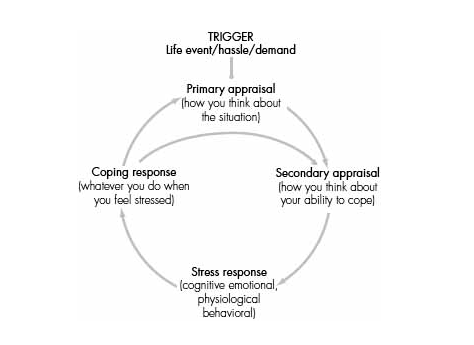 When faced with stress, people have two types of thoughts about it: a primary appraisal (just how great of a problem the stress is for you) and a secondary appraisal (your perceived ability to cope with it). These are the cognitive components of stress. They in turn trigger the other stress components like physical and emotional symptoms. Individuals will attempt to cope with the stress by responding to it. Sometimes this coping behaviour is helpful and the stress subsides. But other times, the behaviour is unhelpful and the stress is reinforced, making your appraisal of the situation and stress more and more negative. This will create a vicious cycle that will maintain the stress. The emotional and physical response to stress also play a role in maintaining the vicious cycle by making you feel frightened or inadequate about the ways you are coping with stress.
-
A Cognitive formulation of stress
Stress depends on cycles between all these different components, so tackling one component should improve the experience of stress. As appraisal is central in the stress response, identifying the stress appraisals is essential. Stress symptoms should alleviate once the blanks are filled in and the vicious cycle broken.
-
How Can I Learn About Stress Management In London?
Our videos on Stress Management
THERAPISTS WHO Treat Stress Management AT PRIVATE THERAPY CLINIC

Tara McCloskey
Cognitive Behavioural Therapist (BABCP)Adults, adolescents & DBT
Fee From: £160
Reviews (17)
Iram Siddiqui
Cognitive Behavioural Therapist (BABCP)Adults, adolescents, CBT & EMDR
Fee From: £150
Reviews (5)
Dr. Vjosa Hyseni
Counselling PsychologistAdults, Families & Adolescents
Fee From: £170
Reviews (40)
Dilek Aygun
Cognitive Behavioural Therapist (BABCP)CBT & EMDR
Fee From: £150
Reviews (11)
Dr. Anthony Newton
Counselling PsychologistPsychologist, Psychotherapist & Counsellor
Fee From: £170
Review (1)
Ellie Vincent
Trainee Clinical PsychologistEating Disorders
Fee From: £170
Review (1)
Dr. Becky Spelman
Counselling PsychologistCBT, Psychodynamic & EMDR
Fee From: £600
Reviews (39)
Luiza Emini
Psychological CounsellorFee From: £80
Reviews (11)
Sofiia Chuhunova
Trainee Counselling PsychologistFee From: £60

Dr. Leon Outar
HCPC Registered PsychologistPerformance & Body image
Fee From: £170

Nazia Uddin
Psychological CounsellorFee From: £80
Review (1)